
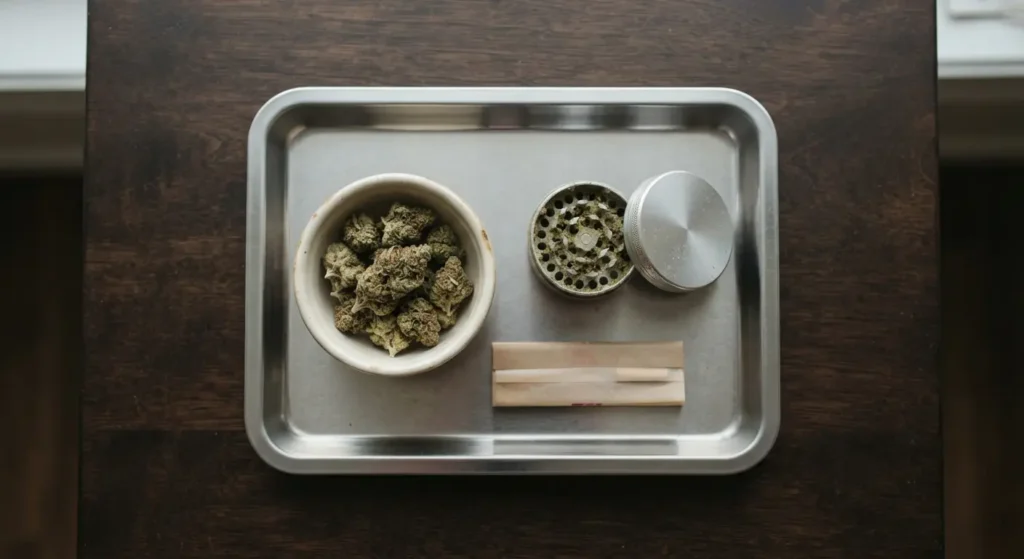
Learning how to roll a joint comes down to airflow. You need ground flower, a paper, and a cardboard filter tip. Set the filter at one end, spread the flower evenly, tuck the paper under, and moisten the gum strip to seal it.
Four core details decide how the joint smokes:
- The grind must stay fluffy so air moves through the flower.
- The cardboard tip keeps plant material out of your mouth and gives the base a solid shape.
- A dry draw before lighting tells you right away if the roll is too tight.
- A tiny bit of moisture activates the glue strip without washing it away.
Why Airflow Controls the Burn
Air has to move freely through the paper tube to keep the burn even. If you roll the paper too tight, you close off the air channels. The cherry starves for oxygen and goes out between pulls.
If you roll too loose, excess air rushes through open pockets. The paper burns away while the flower stays unburned. This causes running or canoeing down one side.
A joint works best when the flower is packed evenly from the filter to the tip. Consistent density lets the lit end pull fresh air through the entire cylinder at an even pace.
Tools You Need Before Rolling
Clear a flat desk or table before you start. Keeping your workspace clear keeps debris out of your flower:
- Cannabis Flower: Use 0.5 to 1 gram of cured bud. Check out our fresh dispensary flower to find strains with proper moisture balance.
- Rolling Papers: Standard 1 1/4 size unbleached hemp papers are easiest to handle because the natural fiber texture gives fingers something to grip.
- A Grinder: A two-piece or four-piece metal grinder shreds dense buds without mashing them flat.
- Filter Tip: Stiff, unprinted cardstock keeps the mouthpiece open.
- Rolling Tray: A tray catches stray bits of flower so you can scoop them back into the roll.
- Packing Tool: A chopstick, pen cap, or small wooden stick helps pack down the open end.
The Parts of a Finished Joint
A standard joint has five main parts:
The filter tip sits at the mouthpiece. It blocks loose material from reaching your lips and stops the base from collapsing when wet.
The body is the center paper cylinder that holds the ground flower column.
The tuck is the paper fold along the bottom edge that wraps over the flower and behind the filter tip.
The gum line is the narrow strip of dried gum Arabic along the top edge of the paper.
The twisted tip is the folded paper point at the top that stops loose flower from falling out before you light it.
Picking Your Rolling Papers
Different paper fibers change how easy the joint is to roll and how fast it burns:
Hemp papers have a visible grain and soft texture. They provide plenty of friction for your thumbs during the tuck. They burn at a steady, medium rate.
Rice papers are thinner and almost clear. They burn slowly and produce little ash. The slick surface makes them harder to grip, and they tear easily if pulled unevenly.
Wood pulp papers are thicker and have a rough texture. They are the easiest papers to roll, but they burn fast and produce more visible ash.
Standard 1 1/4 papers hold about half a gram. King size slim papers run about 100 millimeters long and hold one to two grams for longer sessions.
Step 1: Grind the Flower
Break dense buds into pea-sized chunks with your fingers. Pick out hard stems and seeds. Stems puncture thin paper, while seeds pop and taste harsh when heated.
Put the broken pieces into the grinder teeth. Turn the grinder lid back and forth three or four times.
Look at the texture. The ground flower should look like dried oregano or coarse culinary herbs.
Avoid grinding the flower into powder. Fine green dust forms a dense plug that blocks all airflow. Chunks that are too large leave air pockets that make the joint burn crooked.
Step 2: Make the Filter Tip
Take a strip of cardstock roughly half an inch wide and two inches long.
Make three small accordion folds at one end of the strip. Each fold should measure about three millimeters wide. These folds create a “W” pattern inside the tube.
Wrap the remaining smooth tail of the cardstock around the folded section. Roll it between your fingers into a tight cylinder.
Release your fingers. The paper will spring open slightly into a firm tube with the folded screen locked inside the center.
Step 3: Position the Paper and Filter
Hold the paper horizontally with the sticky gum strip at the top facing toward you. Let the natural center fold sag open into a small trough.
Place the rolled filter tip into one end of the crease. Place it on whichever side feels natural for your dominant hand.
Align the outer edge of the filter flush with the outer edge of the paper.
Hold the filter in place with your thumb and index finger. The cardboard gives you a rigid anchor that determines the diameter of your roll.
Step 4: Fill the Paper
Use your free hand to take ground flower off your tray. Spread it along the paper trough from the filter to the far end.
For a straight joint, distribute the same amount of herb along the entire length. For a cone, keep the flower thin near the filter and widen the layer toward the open end.
Leave roughly a quarter inch of empty paper at the far end. Leaving that space keeps flower from spilling out while you handle the paper.
A standard 1 1/4 paper rolls cleanly with 0.5 grams of flower. Overfilling makes the tuck difficult for beginners.
Step 5: Shape the Flower
Pick up the loaded paper using both hands. Grip the paper between your thumbs and index fingers, keeping the flower resting inside the trough.
Roll your thumbs up and down against your fingers. Do not squeeze the flower. You are simply shaping loose material into a rounded cylinder.
Make sure the flower sits flush against the edge of the cardboard filter. Any empty gap between the flower and the filter causes the joint to bend and collapse when held.
Step 6: Tuck and Roll
The tuck locks the shape in place. Work slowly from the filter end toward the tip.
Use your thumbs to fold the unglued bottom flap of paper over the flower and tuck it behind the cardboard filter.
Once that edge catches behind the filter, guide the rest of the bottom flap behind the flower column using your index fingers.
Keep light outward tension with your thumbs. Roll the cylinder upward until only the shiny gum strip is exposed along the top.
Step 7: Moisten and Seal the Gum Line
Run your tongue along the gum strip with light pressure. You only need a thin layer of moisture to activate the gum Arabic.
Do not wet the paper heavily. Excess saliva dissolves the glue line and prevents the paper from sticking.
Press the wet gum strip down onto the paper body. Start at the filter end and work your way out to the open tip.
Smooth the paper down with your thumb to push out trapped air pockets. Let the paper dry undisturbed for ten seconds so the seam sets.
Step 8: Test the Airflow and Pack
Place the filter tip between your lips and take a dry pull before you close the open end.
Air should move through the cylinder with the resistance of drinking through a straw. If you have to pull hard, the flower is packed too tight. Roll the joint gently between your palms to loosen the packed material.
Tap the cardboard filter flat against your table three times. Gravity drops the loose flower down against the filter base.
Take a packing stick and press down on the exposed flower at the open tip with light pressure. Do not push hard, or you will compact the tip into a solid plug.
Step 9: Twist the Tip
Check the paper at the open end. You should have roughly a quarter inch of empty paper extending past the packed flower.
Pinch the empty paper flat between your thumb and index finger. Twist the paper two or three turns into a pointed wick.
The twist closes the cylinder so loose flower does not fall out during transport. The joint is now ready to use.
Common Mistakes and Fixes
| Problem | Root Cause | Fix |
| Canoeing (burns down one side) | Loose pockets of air or uneven lighting | Touch a wet fingertip directly below the fast burn to slow that side down. |
| Clogged draw | Flower ground too fine or packed too tight | Roll the joint gently between your fingers to break up the dense flower column. |
| Floppy base | Gap between the flower and the filter tip | Tap the filter base on a hard surface, or push the filter deeper into the paper. |
| Open seam | Too much moisture washed away the gum | Moisten the seam with a damp fingertip and hold it down for 15 seconds. |
For state rules on adult-use possession, limits, and safe storage, review the NYS Office of Cannabis Management portal.
Storing Joints for Freshness
Rolled joints dry out if left exposed to open air. Heat, light, and circulating air evaporate moisture from the flower and make the smoke harsh.
Store finished joints inside an airtight plastic doob tube or a small glass jar. Keep the container in a cool, dark drawer away from direct sunlight.
If the flower feels brittle before you roll, place a small 62 percent relative humidity pack inside your storage jar for two days to bring back proper moisture.
Frequently Asked Questions
Can I Roll Without a Grinder?
Yes. Use clean kitchen shears or break the flower apart by hand. Keep the pieces uniform so the joint burns at an even rate.
What Is the Difference Between a Joint, a Spliff, and a Blunt?
A joint uses rolling paper and pure cannabis flower. A spliff mixes cannabis flower with tobacco inside rolling paper. A blunt wraps cannabis flower in a tobacco leaf or reconstituted cigar paper.
Why Does a Joint Go Out Between Hits?
A joint goes out when air cannot reach the lit cherry. This happens when the flower is packed too tightly, ground into fine dust, or overly damp.
Are Hemp Papers Better for Beginners Than Rice Papers?
Yes. Hemp papers have a textured plant fiber surface that is easier to grip during the tuck. Rice papers are smooth and slide around in your fingers.
Visit Our Arthur Avenue Dispensary
Looking for rolling supplies or fresh flower in the Bronx? Stop by our Arthur Avenue shop to pick up papers, grinders, and whole flower. You can also contact our team with questions about our current menu.
Visit Guardian Wellness Dispensary
Compliance Notice: Cannabis is for use only by adults 21 years of age and older. Keep all cannabis products out of reach of children and pets. Do not operate a vehicle or machinery under the influence of cannabis. Do not cross state lines: Transporting cannabis across state lines is illegal under federal law, even between states with adult-use legal markets.
FDA Disclaimer: These statements have not been evaluated by the Food and Drug Administration. These products are not intended to diagnose, treat, cure, or prevent any disease.