
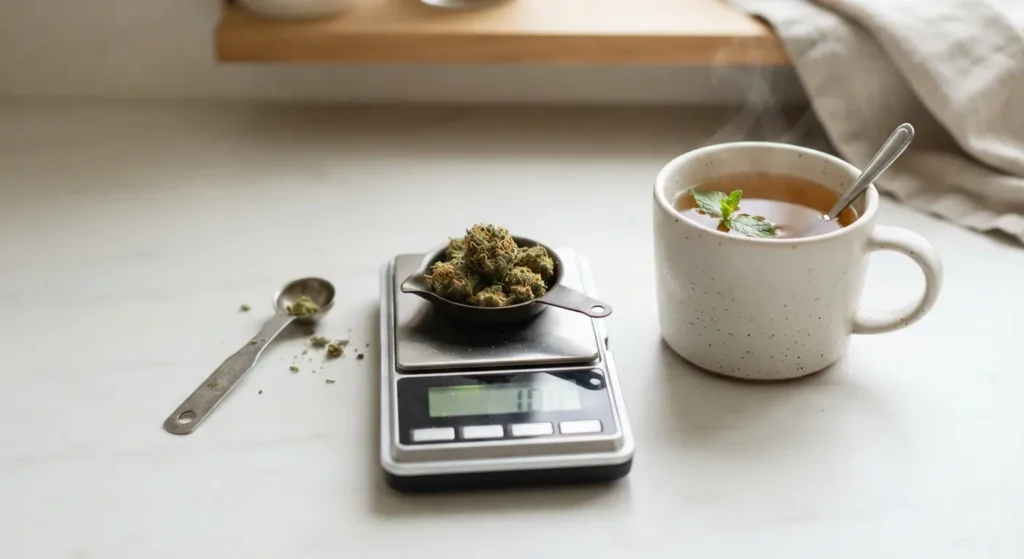
Making cannabis tea at home starts with two things most guides skip. You need to activate the flower with heat, then add a fat source so your body can absorb it. Skip either step and you’ll end up with a cup that tastes like grass and does very little else. This guide walks through both steps, plus dosing, timing, and safe storage.
Key Takeaways
- Raw cannabis must be heated first (decarboxylated) before it produces any effects in tea.
- THC is fat-soluble, so tea needs butter, coconut oil, or full-fat milk to work.
- New York caps store-bought edibles at 10 mg of THC per serving, a useful benchmark for homemade doses.
- Effects from cannabis tea can take 30 to 90 minutes to appear and shouldn’t be rushed with a second cup.
- Homemade tea and dispensary tinctures each have real trade-offs in precision and convenience.
What You Need Before You Start
A basic cannabis tea recipe needs four things: ground cannabis flower, a fat source, hot water, and your tea of choice. One gram of flower is a common starting point for one to two mugs.
For the fat, use one tablespoon of unsalted butter, coconut oil, or a splash of whole milk. THC and other cannabinoids are lipophilic. They dissolve in fat rather than water, which is why this step pulls the compound into your cup.
This limited water solubility is one reason for THC’s low oral bioavailability. Once swallowed, only about 6% is absorbed on average, with a documented range of roughly 4% to 12%.
You’ll also need a fine mesh strainer or cheesecloth to remove plant material before drinking.
Why Decarboxylation Comes First
Raw cannabis flower contains THCA, a compound that doesn’t produce a high on its own. Applying heat converts THCA into THC, the active compound responsible for cannabis’s psychoactive effects, in a chemical reaction called decarboxylation. Skipping this step means your tea will have little to no effect no matter how much flower you use.
To decarboxylate, spread coarsely ground flower on a parchment-lined baking sheet. A 2021 study tested temperatures from 80°C to 150°C over five- to sixty-minute windows. It found that roughly 150°C (300°F) for about 40 minutes produced strong cannabinoid conversion. Many home users aim slightly lower, around 240°F for 30 to 40 minutes, to protect flavor while still fully activating the flower.
Let the tray cool for a few minutes once it’s done. The flower should look slightly darker and smell noticeably stronger. That change is a good visual cue that decarboxylation has taken place.
How to Make Cannabis Tea: Step by Step
- Decarboxylate your flower. Bake ground cannabis at 240°F for 30 to 40 minutes, stirring once halfway through.
- Boil your water. Bring one cup of water to a boil per mug, then reduce to a simmer.
- Add your fat source. Stir in one tablespoon of unsalted butter, coconut oil, or whole milk per mug.
- Add the cannabis. Stir in the decarboxylated flower and let it simmer gently for 7 to 10 minutes.
- Add your tea bag or loose leaf. Steep for the last 3 to 5 minutes alongside the cannabis.
- Strain thoroughly. Use a fine mesh strainer or cheesecloth to remove all plant matter.
- Sweeten and serve. Honey, cinnamon, or a splash of milk can help mask the plant flavor.
Choosing Your Cannabis for Tea
You don’t have to start with raw flower. A dispensary tincture is already decarboxylated and lab-tested, so you can skip the baking step entirely and stir a measured dose straight into hot water.
This route trades a bit of ritual for real precision. Because tinctures list an exact milligram count per dropper, you know your dose before you ever pick up the mug. Flower-based tea depends on your flower’s THC percentage and how thoroughly it was decarboxylated. Both are harder to pin down at home.
How Much THC Should You Use?
Dosing homemade tea is a guessing game unless you calculate it. New York’s Office of Cannabis Management limits every single serving of a licensed orally ingested product to no more than 10 mg of total THC. That number is a useful ceiling to aim for at home too.
One gram of flower at 20% THC contains roughly 200 mg of total THC before any is lost to straining or simmering. Splitting that gram across four mugs puts each serving closer to the legal 10 mg benchmark. Home extraction is never as exact as a lab-tested product, though.
If you’re new to edibles, start with a half mug and wait before finishing the rest. It’s far easier to drink more than to undo a dose that’s already stronger than planned.
What to Expect: Onset, Peak, and Duration
Cannabis tea behaves like any other edible once it’s in your system. Effects typically begin 30 to 90 minutes after drinking and reach their strongest point around 2 to 3 hours in. Total duration can run 4 to 12 hours depending on the dose.
That delay comes down to digestion. A study measuring five commercial 10 mg-THC edibles found plasma THC levels peaked anywhere from 35 to 90 minutes after ingestion. That range explains why two people can drink the same cup and feel it at very different times.
Smoking or vaping produces effects within minutes because THC bypasses digestion entirely. Tea takes longer to kick in, but many people find the effects last noticeably longer as a result.
The Redosing Mistake That Ruins a First Try
The most common cannabis tea mistake is deciding too early that a cup “didn’t work.” Because onset can take up to 90 minutes, drinking a second cup at the 40-minute mark often means both doses hit at once.
New York requires every legal edible to carry the warning that effects may be delayed by four or more hours. That same patience applies to a homemade cup. Set a timer for at least 90 minutes before deciding whether to have more.
Storing Your Cannabis Tea Safely
Cannabis tea made with butter or milk is a perishable, fat-based beverage, not a shelf-stable drink. General USDA food safety guidance holds that perishable homemade foods and beverages should be refrigerated and used within three to four days. Discard it if it’s left above 40°F for more than two hours.
Store leftover tea in an opaque, labeled, child-resistant container in the refrigerator, away from anything a child or pet might mistake for a snack. A national poison control analysis found pediatric cannabis edible exposures in children under 6 jumped from 207 cases in 2017 to 3,054 cases in 2021. Nearly all of those exposures happened at home. New York’s own packaging rules require every product to warn “KEEP OUT OF REACH OF CHILDREN AND PETS” and list the Poison Center number. The same precaution is worth applying to anything you brew yourself.
Homemade Tea vs. Dispensary Beverages and Tinctures
| Homemade Cannabis Tea | Dispensary Tincture or Beverage | |
| Dosing accuracy | Estimated from flower potency | Printed in mg per serving |
| Lab testing | None | Required, with a scannable Certificate of Analysis |
| Prep time | 30 to 45 minutes | Under 1 minute |
| Onset consistency | Varies with fat content and steep time | More consistent, batch to batch |
| Cost per serving | Lower, if flower is on hand | Slightly higher, for tested precision |
Neither option is wrong. Homemade tea is a relaxed, low-cost ritual for people who already enjoy cooking with cannabis. A dispensary tincture is the better call when precise, repeatable dosing matters most.
Making Cannabis Tea Part of Your Routine
Once you’ve made a batch or two, cannabis tea becomes less about the recipe and more about the routine around it. A quiet cup in the evening, timed correctly and dosed conservatively, is one of the more approachable ways to unwind with cannabis.
Whether you stick with flower or switch to a tincture-based version, the two fundamentals stay the same: decarboxylate for activation, and add fat for absorption. Get those two steps right, and everything else is just taste.
Explore Guardian Wellness’s Tincture and Edibles Selection
If measuring flower and running the oven isn’t your idea of a relaxing evening, our lab-tested tinctures and edibles do the dosing math for you. Browse our current menu online and pick up in the Bronx today.
Frequently Asked Questions
Does cannabis tea get you high without decarboxylating first? No. Raw cannabis contains THCA, which produces no intoxicating effect until it’s converted to THC through heat.
Why does my cannabis tea need butter or oil? THC is fat-soluble, not water-soluble. A fat source carries the cannabinoids into your tea instead of leaving them behind in the plant matter.
How long does homemade cannabis tea last in the fridge? Treat it like any perishable, fat-based drink and use it within three to four days of refrigeration.
Can I use cannabis stems or trim instead of flower? Yes, though stems and trim generally contain far less THC than flower, so expect a milder cup.
Is cannabis tea legal to make at home in New York? Adults 21 and older may legally possess and prepare cannabis purchased from a licensed dispensary, in line with New York’s adult-use law.
This is a licensed New York State cannabis advertisement.
Required Warning: For use only by adults 21 years of age and older. Keep out of reach of children and pets. In case of accidental ingestion or overconsumption, contact the Poison Center at 1-800-222-1222 or call 9-1-1. Please consume responsibly.
Rotating Warning: Cannabis is not recommended for use by persons who are pregnant or nursing.
HOPEline: Concerned about your cannabis use? Contact the New York State HOPEline by texting “HopeNY,” calling 1-877-8-HOPENY, or visiting oasas.ny.gov/HOPELine.
Cannabis remains illegal under federal law. As of 2026, this still applies to state-licensed adult-use products, even though certain FDA-approved and state medical marijuana programs have been reclassified. Products purchased at Guardian Wellness are intended for use only within New York State. Transporting cannabis across state lines, even between two states where cannabis is legal, is a federal offense.
Guardian Wellness Cannabis Dispensary, License No. OCM-RETL-24-000171 | 2500 Arthur Avenue, Bronx, NY 10458