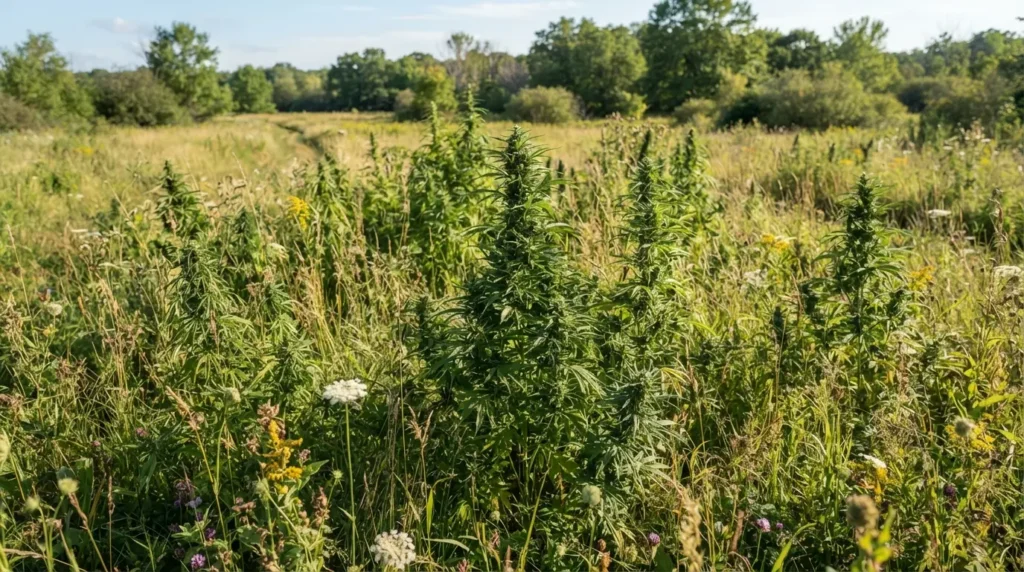
Wild cannabis grows in disturbed, sunny patches of soil around the world. It shows up in roadside ditches across the American Midwest and in the mountain foothills of Central Asia. It also turns up in vacant lots that people have already cleared or dug up. This uncultivated version of the plant is often called feral cannabis or ditch weed. It looks and behaves very differently from the flower sold at a licensed dispensary. New York City had its own wild cannabis problem in the mid-1900s, including patches that grew right here in the Bronx. This guide covers where wild cannabis grows and why it isn’t the same as dispensary cannabis. It also covers what New York law says about a plant you might spot growing on its own.
Key Takeaways
- Wild, uncultivated cannabis is usually called feral cannabis or ditch weed, and it typically carries far less THC than cultivated flower.
- Cannabis most likely originated in Central Asia and spread through both early cultivation and natural seed dispersal.
- New York City had a documented wild cannabis problem in the mid-20th century, including plants that grew in the Bronx.
- Picking or growing a cannabis plant found in New York still falls under state cannabis law, even though adult-use cannabis is legal here.
- Dispensary cannabis is lab-tested for potency and contaminants before it reaches a shelf. A wild plant is not.
What Is Wild Cannabis, Exactly?
Wild cannabis is a plant growing on its own, with no one planting, watering, or tending it. This type of plant is commonly called ditch weed. The U.S. Department of Justice defines it as wild and scattered marijuana with no evidence of planting, fertilizing, or tending (U.S. Department of Justice, Bureau of Justice Statistics, 1991).
Most wild cannabis in North America descends from hemp crops grown decades ago for fiber, not from high-THC plants bred for potency. Federal eradication data backs this up directly. In 1993 alone, the DEA’s Domestic Cannabis Eradication/Suppression Program destroyed 387.9 million wild ditch weed plants. That same year, the program destroyed just 4.33 million cultivated marijuana plants (U.S. Department of Justice, Office of Justice Programs, 1993). The program has run since 1979 as a joint federal and state effort to remove cannabis growing outside any licensed system.
Where Cannabis Originated and Spread on Its Own
Genetic and botanical research points to Central Asia as the plant’s likely place of origin. Cannabis populations later spread into South Asia, the Middle East, and eventually the rest of the world (National Center for Biotechnology Information, 2021). Humans carried the plant along trade routes, and it also spread on its own wherever growing conditions allowed.
Researchers generally group cannabis into three types based on where each one adapted to grow:
- Sativa: Associated with warmer regions of South and Southeast Asia, historically grown tall with narrow leaves.
- Indica: Associated with Central Asia, including present-day Afghanistan and Pakistan, adapted to drier mountain climates.
- Ruderalis: A hardy, low-THC type native to Central Asia, Russia, and Eastern Europe. It adapted to cold, low-light conditions (National Center for Biotechnology Information, Botanical Studies, 2019).
These categories describe wild and landrace populations more precisely than they describe most modern dispensary strains, which have been cross-bred for generations.
Where Feral Cannabis Still Grows in the U.S. Today
The Midwest holds the largest share of wild cannabis in the country. Much of it traces back to hemp fields planted during World War II under a federal fiber-crop program. When that program ended, many fields were abandoned. The hemp plants kept reseeding themselves year after year.
That history still shows up in federal data. States like Indiana have reported eradicating well over 200 million ditch weed plants in a single year, far more than any other state (U.S. Department of Justice, Office of Justice Programs, historical DCE/SP reporting). This type of plant is descended from fiber hemp, so it typically carries low or negligible THC. That’s part of why the DEA has scaled back active eradication of it in several states.
Yes, Wild Cannabis Grew in New York City Too
New York isn’t usually part of the wild cannabis conversation, but it has its own documented history. In the summer of 1951, city sanitation crews uprooted an estimated 41,000 pounds of cannabis plants growing on their own across New York City. These plants covered vacant lots and underpasses, including sites in the Bronx (Brooklyn Public Library historical archives, 2011). Some of the plants removed that summer reportedly reached ten feet tall.
This wasn’t a one-summer event. Sanitation crews had been pulling wild-growing plants from empty lots for years before that. Much of it traced back to hemp and cannabis plantings that had spread on their own through undeveloped parts of the city. Feral cannabis has never been strictly a rural, Midwest phenomenon.
Wild Cannabis vs. Dispensary Cannabis
A wild plant and a dispensary product both come from the same genus, but that’s often where the similarity ends.
| Wild/Feral Cannabis | Dispensary Cannabis | |
| THC content | Typically very low, often close to undetectable | Measured and printed on every package |
| Testing | None | Required lab testing for potency, pesticides, heavy metals, mold, and other contaminants (NY Office of Cannabis Management, 2026) |
| Consistency | Varies plant to plant, lot to lot | Standardized within each tested batch |
| Legal status to possess | Ambiguous without testing; treated as marijuana under state law unless proven to meet the hemp definition | Clearly legal for adults 21+ when purchased from a licensed retailer |
New York requires every adult-use and medical cannabis product to pass testing before it can be sold. That testing covers heavy metals, pesticides, mold, and other microbial contaminants (NY Office of Cannabis Management, 2026). A plant found growing in a lot has none of that testing behind it. There’s no reliable way to know its potency or safety just by looking at it.
Is It Legal to Pick or Grow Wild Cannabis in the Bronx?
New York legalized adult-use cannabis on March 31, 2021, under the Marihuana Regulation and Taxation Act (NY Office of Cannabis Management, 2021). That law also opened the door to legal home cultivation, but it comes with specific limits.
Adults 21 and older can grow up to 3 mature and 3 immature plants each. A household cap of 6 mature and 6 immature plants applies no matter how many adults live there. Homegrown cannabis can’t be sold, traded, or bartered. Plants must also be kept secure and out of reach of anyone under 21 (NY Office of Cannabis Management, Adult-Use Information, 2026).
None of this covers a plant someone simply finds growing wild. Federal law draws a line between hemp and marijuana based on THC content. That line is set at 0.3% total THC on a dry-weight basis, under the 2018 Farm Bill and later amendments (Library of Congress, 2025). A wild plant’s THC level can’t be confirmed without a lab test. New York law treats an unidentified cannabis plant as regulated marijuana unless proven otherwise. Picking or transplanting one isn’t the same as legally growing your own under the state’s home-cultivation rules.
Unregulated cultivation carries real risk beyond the legal question, too. In September 2024, New York City agencies including the FDNY shut down an illegal cannabis grow operation in a Bronx residential building. Officials cited serious fire and electrical hazards tied to the unpermitted growing setup (FDNY, City of New York, 2024). Licensed cultivation exists in part to keep operations like this out of residential buildings.
How to Get Cannabis Legally in the Bronx
The simplest way to get cannabis without questions about potency, safety, or legality is through a licensed retailer. Guardian Wellness carries flower, edibles, vapes, and more, all tested under New York’s OCM requirements before it reaches the shelf. Every product comes with a certificate of analysis, so there’s no guessing involved.
From Roadside Weed to Regulated Flower
Wild cannabis is a real, documented part of the plant’s history, from Central Asian mountainsides to Midwest ditches to, briefly, the vacant lots of the Bronx. But the plant growing on its own in a field and the flower on a dispensary shelf aren’t interchangeable. One is untested and unpredictable. The other has a paper trail showing exactly what’s in it.
Explore Guardian Wellness’s Bronx Flower Selection
Guardian Wellness stocks a rotating selection of lab-tested flower, from classic strains to newer drops. Every product listed comes with a certificate of analysis covering potency and contaminants. Browse the current lineup and order ahead for pickup at our Bronx flower selection.
Frequently Asked Questions
Is wild cannabis the same as marijuana? Botanically, yes. Wild cannabis is the same plant species. It’s usually descended from low-THC hemp rather than high-THC cultivars, so its effects and potency are very different from dispensary flower.
Can I legally pick cannabis I find growing wild in New York? Not automatically. New York’s home-cultivation rules cover plants adults grow themselves under specific limits. A wild plant’s legal status depends on THC content that can’t be confirmed without lab testing.
Why does wild cannabis have less THC than dispensary flower? Most wild cannabis in the U.S. descends from hemp grown for fiber, which was never bred for potency. Dispensary flower comes from cultivars selectively bred over generations specifically for higher THC content.
Does cannabis still grow wild in the Bronx today? Documented large-scale wild growth in the Bronx dates back to the mid-1900s. Isolated feral plants can still turn up in overgrown urban lots today, though nothing comparable to the 1951 removal effort has been reported.
Cannabis remains illegal under federal law. Products purchased at Guardian Wellness are intended for use only within New York State. Transporting cannabis across state lines, even between two states where cannabis is legal, is a federal offense. Please consume responsibly and within state borders.
These statements have not been evaluated by the Food and Drug Administration. This product is not intended to diagnose, treat, cure, or prevent any disease. Cannabis products should not be used by pregnant or breastfeeding individuals. Keep out of reach of children and pets. For use only by adults 21 and older, or by qualified medical patients in accordance with New York State law. Consult a physician before use if you have a medical condition or take prescription medications.