
Sativa vs. indica is the first question most budtenders hear on Arthur Avenue. The short menu answer, sativa for energy, indica for relaxation, isn’t wrong. It’s just incomplete. That framework comes from how plants were classified over two centuries ago, not from how today’s hybridized strains behave. What actually determines how a product feels is its individual mix of cannabinoids and terpenes. That’s exactly the information New York requires dispensaries to put on the label.
Key Takeaways
- The sativa/indica split started as a plant-shape classification in the 1700s, not an effects classification.
- Genetic testing shows strain names often don’t match a plant’s actual sativa or indica ancestry.
- Terpenes and cannabinoids, not the sativa/indica label, are what research links most closely to how a product feels.
- New York requires every product label to show cannabinoid percentages, the cultivar name, and a QR code linking to lab results.
- Onset time depends more on how you consume a product (smoking, vaping, or eating it) than on whether it’s labeled sativa or indica.
What “Sativa” and “Indica” Originally Meant
Sativa and indica started as plant shapes, not experiences. Carl Linnaeus classified all cannabis as a single species, Cannabis sativa, in 1753. Cannabis indica didn’t exist as a category until 1785. That year, botanist Jean-Baptiste Lamarck examined plant specimens from India and decided they warranted a second species.
Lamarck’s distinction was about the plant’s body, not its high. He based it on shorter, woodier stems, alternating branches, and narrower leaflets, compared to the Cannabis sativa Linnaeus had described. A third category, Cannabis ruderalis, followed in 1924 for a hardier, low-THC variety found in Russia. None of these classifications were built around how the plant made a person feel. That association, sativa for energy, indica for calm, was layered on later by growers and breeders. It stuck anyway.
Why the Label Doesn’t Reliably Predict Effects Anymore
Modern breeding has blurred the line these labels were built on. Decades of cross-breeding mean a strain sold as “pure sativa” or “pure indica” today rarely has a clean genetic lineage back to either original classification. A 2015 genetic study analyzed 81 marijuana samples. It found only a moderate correlation between a plant’s actual genetic ancestry and its labeled sativa or indica heritage. The study concluded that strain names often don’t reflect a meaningful genetic identity.
That same research turned up a surprising result. Hemp plants, grown for fiber and seed rather than for their effects, turned out to be genetically closer to indica-type marijuana than to sativa-type strains. The researchers also described the traditional assumption: tall, narrow-leafed sativa plants producing stimulating effects, and short, wide-leafed indica plants producing sedating ones. Their genetic data only partly lined up with that assumption. In short, a name on a jar is a decent guess at a plant’s growing habits. It’s a weaker guess at what you’ll actually feel.
What Actually Drives How a Strain Feels
If sativa and indica aren’t reliable predictors, what is? Current research points to the chemovar instead, the specific mix of cannabinoids (like THC and CBD) and terpenes (a strain’s aroma compounds) in that batch. A 2024 review found terpenoid content, more than cannabinoid ratios alone, is now the most distinctive marker separating one chemovar from another. A 2022 classification study backed this up. Combining cannabinoid and terpene data together told chemovars apart better than looking at either factor alone.
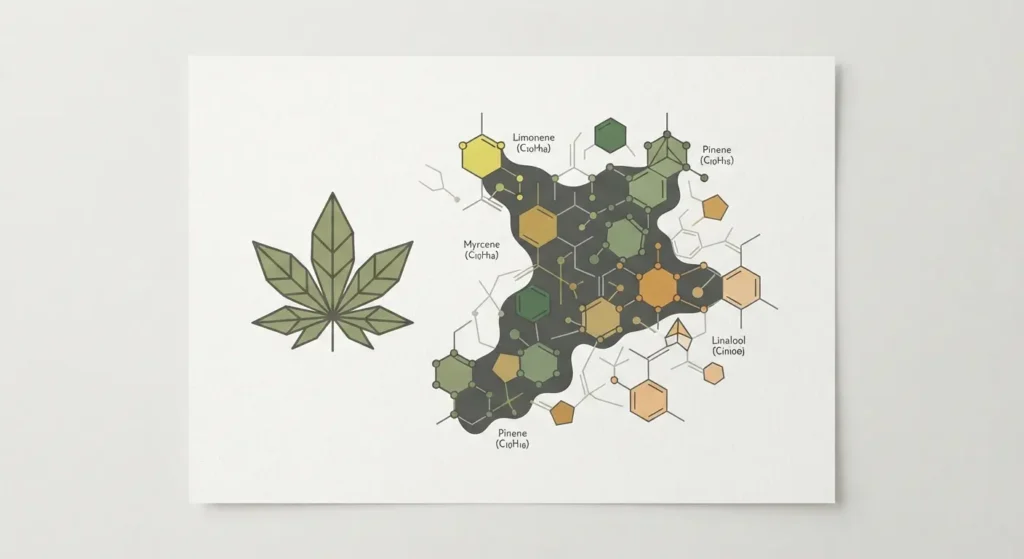
Terpenes aren’t just along for the ride, either. A 2021 study in Scientific Reports found certain cannabis terpenes can directly activate cannabinoid receptors. They can also modulate how THC behaves in the body, meaning they may help shape the experience rather than just add scent. Some of the terpenes you’ll see listed on a New York label include:
- Myrcene: earthy, herbal aroma; commonly found in strains customers describe as heavy or mellow.
- Limonene: citrus aroma; commonly found in strains customers describe as bright or uplifting.
- Pinene: pine aroma; associated with alertness in customer-reported experience.
- Linalool: floral, lavender-like aroma; associated with a calming sensation.
- Caryophyllene: peppery, spicy aroma; the only terpene known to interact directly with the CB2 cannabinoid receptor.
A 2023 study built a chemovar index using real-time data logged by 204 people across 6,309 individual cannabis sessions and 633 distinct flower products. It treats the full chemical profile, not the sativa/indica label, as the meaningful variable.
How to Read a New York Cannabis Label
New York’s cannabis labels are built to give you this exact chemovar information. The state’s Office of Cannabis Management (OCM) requires flower, pre-rolls, and vape cartridges to list the percentage of each cannabinoid on the package. These labels typically include the cultivar or strain name as well. Every legal product also carries a QR code or link to its Certificate of Analysis (COA). That’s the lab report showing the tested cannabinoid and terpene content for that batch.
The state also holds labels to a tolerance standard. Adult-use product labels must fall within 85% to 115% of the stated THC amount. That means the number on the package should be close to what a lab would find on a retest. For edibles, OCM caps every single serving at 10 mg of total THC, regardless of how the product is packaged. Next time you’re at the counter, ask to see the COA or scan the QR code before choosing sativa, indica, or hybrid. The terpene breakdown on that report says more about the actual experience than the category on the shelf tag.
Sativa vs. Indica vs. Hybrid: Quick Comparison
| Sativa | Indica | Hybrid | |
| Traditional plant shape | Tall, narrow leaves | Short, wide leaves | Mixed genetics |
| Commonly reported feel | Uplifted, energized | Relaxed, sedated | Varies by chemovar |
| Best-known use case | Daytime, social settings | Evening, winding down | Depends on dominant terpenes |
| Reliability of the label alone | Low, genetics vary widely | Low, genetics vary widely | Not applicable; check the COA |
Most products on a modern menu, including at Guardian Wellness, are hybrids in some form. That’s exactly why the terpene and cannabinoid breakdown on the label matters more than which of these three words is printed on the jar.
How Fast You’ll Feel It: Flower, Vape, and Edibles
Onset time depends far more on how you consume a product than on whether it’s labeled sativa or indica. Smoked or vaped flower and vape cartridges reach the bloodstream through the lungs. Effects are typically noticeable within a few minutes, peaking within 15 to 30 minutes. Edibles work differently. THC has to pass through the digestive system and liver first. That usually takes 30 minutes to 2 hours before effects begin, and the full peak can take even longer.
That timing difference matters more for your evening plans than the sativa/indica label does. A fast-onset vape lets you gauge the effect and stop there if that’s enough. An edible’s delayed onset means the dose you took 45 minutes ago may not be the dose you’re about to feel. New York’s 10 mg per-serving cap exists partly because it’s easy to underestimate an edible before it fully kicks in. Whatever the format, start low, wait out the full onset window, and reassess before taking more.
Choosing What Fits Your Day
With the science in mind, the sativa/indica shorthand still works fine as a starting conversation with a budtender. It’s just not the whole conversation. If you want something for a social afternoon, a chemovar higher in limonene or pinene is a reasonable place to start. If you’re winding down after a shift, a myrcene- or linalool-forward profile is a common customer preference. From there, the cultivar’s lab-tested terpene content on the COA narrows down the right product for that day, not the shelf tag label.
THC produces its effects by binding to cannabinoid receptors in the body’s natural endocannabinoid system. This network is involved in memory, coordination, and time perception. That same activation is also what triggers the brain’s dopamine reward pathway. CBD, when present in a product, can offset some of THC’s acute effects by acting on that receptor system differently. That interaction between cannabinoids, not the sativa/indica name, is a big part of why two products with the same label can feel noticeably different.
Ask Us Before You Decide
The fastest way to cut through the sativa/indica guesswork is to ask. Our budtenders check the COA on any product you’re curious about and walk you through its actual terpene and cannabinoid breakdown. Stop by 2500 Arthur Avenue, or place an order ahead if you already know what you’re looking for.
Explore Guardian Wellness’s Flower Selection
Ready to see the chemovar breakdown for yourself? Our current flower menu lists cannabinoid percentages and terpene highlights for every strain in stock, so you can shop by profile instead of guesswork. Browse our flower selection to get started.
Frequently Asked Questions
Is sativa or indica better for daytime use?
Products commonly labeled sativa are more often associated with daytime, energizing use. The specific terpene profile, particularly limonene or pinene content, is a more reliable guide than the label alone.
Why do two products labeled “indica” sometimes feel different?
Because “indica” describes a loose category, not a fixed chemical formula. Two products with the same label can have very different cannabinoid and terpene content. Checking the COA gives a clearer picture than the category name alone.
Do I need a medical card to shop at Guardian Wellness?
No. Guardian Wellness operates as an adult-use dispensary, so any customer 21 or older with valid ID can shop, no medical card required.
How do I find a product’s terpene profile before buying?
Every legal New York cannabis product includes a QR code linking to its Certificate of Analysis (COA), which lists the tested cannabinoid and terpene content. You can also ask a budtender to pull it up for you at the counter.
Does the sativa/indica type affect how long it takes to feel effects?
Not directly. Onset time depends mainly on the consumption method. Inhaled products act within minutes, while edibles typically take 30 minutes to 2 hours, regardless of whether the product is labeled sativa, indica, or hybrid.
Cannabis remains illegal under federal law. Products purchased at Guardian Wellness Cannabis Dispensary are intended for use only within New York State. Transporting cannabis across state lines, even between two states where cannabis is legal, is a federal offense. Please consume responsibly and within New York’s borders.
These statements have not been evaluated by the Food and Drug Administration. This product is not intended to diagnose, treat, cure, or prevent any disease. Cannabis products should not be used by pregnant or breastfeeding individuals. Keep out of reach of children and pets. For use only by adults 21 and older.